“To be successful, horse and rider must commit to each other 100%.” Here, the greats of show jumping agree. This thrilling equestrian discipline requires patience, hard work, and above all – trust. The goal of a show jumper is to overcome various courses in fine coordination with their equine partner. The whole process should be stylistic and as fast as possible, without knocking down a single rail.
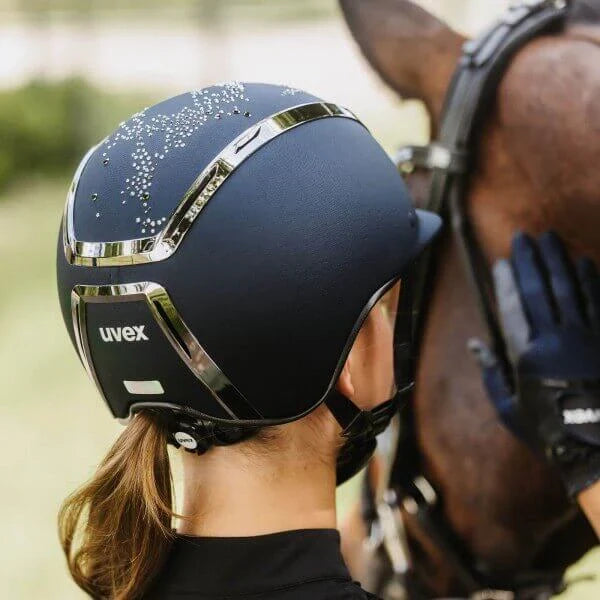
Many thanks to @beroett for the photos!
How did show jumping actually originate?
The fox hunts of the 19th century are considered the foundation for today’s most widespread equestrian discipline, show jumping. Back then, riders overcame all obstacles in the terrain that came their way. Logs, hedges, and ditches were tackled by groups of riders. The fox hunt quickly became a social event and attracted a large number of spectators.
Into the rail forest!
Later, the very long courses were confined to a marked area so that the sequence of jumps was easier for spectators to follow, marking the birth of the show jumping course.
The cumbersome natural obstacles were soon replaced by rails and gates, which were easier to transport. In 1864, the first official show jumping competition took place in Dublin. The first Olympic show jumping event was held in 1900 during the Paris Games, which went down in history as the first international show jumping competition.
What elements belong to a show jumping course?
A classic show jumping course usually consists of 8 to 11 obstacles, which the course designer can adapt to the conditions of the arena and the field of competitors.
The various obstacles and obstacle combinations, with varying technical demands, always create a different level of difficulty.
What types of obstacles are there?
The following obstacles are most commonly found in a tournament course:
The vertical jump, the oxer, and the so-called triple bar.
The vertical jump is a high jump, built with two jump standards and several rails stacked on top of each other. Often, planks and bases are also used here.
The oxer belongs to the high and wide jumps. The difference from the vertical jump is that the horse extends its jump not only in height but also in width. Oxers are built with four jump standards, on which the rails are placed in two rows one behind the other. In difficult competitions, oxers can be built up to two meters wide.
The triple bar is a special type of high and wide jump. This obstacle is built in three ascending stages in a row. The triple bar appears as a very massive and wide jump when approached, but riders of higher levels like to tackle it. This is because the horse can easily and well develop the flight curve with this type of high and wide jump.
What types of obstacle combinations are there?
When it comes to sequences of connected obstacles within a course, show jumpers talk about combinations and distances. These are built with fixed measurements and belong to the technical demands of a show jumping course. A combination is a sequence of two to three jumps with one or two strides in between. The distance between jumps in a combination with one stride is seven to eight meters. Combinations with two strides are measured at 10-11 meters.
Besides combinations, you can also find the following types of distances in a show jumping course:
From ground poles to tournament course – how to approach this discipline
Every beginning is hard, but once ambition takes hold, you want to go further and higher. Of course, setbacks must be expected, but as the saying goes: practice makes perfect! We’ll show you what the first steps look like.
A solid dressage foundation should be the basis for show jumping. It is especially important that you have a stable basic seat. To further stabilize this and prepare for the movements over a jump, you should initially incorporate poles into your daily work with your horse. A good exercise to train your balance, coordination, and distance feel is two poles placed in a straight line with a distance of 17 meters.
We recommend using pole blocks to minimize the risk of injury from stepping on the pole.
At the beginning, you should only overcome one pole at a trot to get your horse and yourself used to the new movement. It is important to take a light seat. Lean your upper body slightly forward and keep a giving hand so your horse is not disturbed. Once this works well on both reins, you can add the canter. Especially in the course, many jumps often follow quickly one after another, so early sight and the centered approach to an obstacle are fundamental basics you should always keep in mind.
Try to bring the pole into the middle of your horse’s canter stride with a steady rhythm and the use of your weight, leg, and rein aids. Once you have a good feeling, you can add the second pole. Pay special attention to keeping your horse straight to maintain a straight line between the poles.
As the next step, we recommend setting up a small cross with a ground pole (distance of 2.20m – 2.50m), which is initially overcome at a trot. The ground pole provides the horse with a good takeoff point, and the rider can focus more on their jumping position. Repeat overcoming the obstacle a few times before changing to the next gait. Move the ground pole half a meter further from the jump. Recall the previously mentioned basics and let the jump come to you. You’ll see that by then, ambition will have definitely caught you! :-)
As you progress, the height of the jumps is not the decisive factor, but gaining routine over the number of jumps to build trust with your horse. A series of obstacles helps you get to know the feeling of several jumps in a row and to stabilize your seat. For your first distance, don’t overthink it; just remember our pole exercise at the beginning. As a boundary, you or your riding instructor can place poles beside the obstacles on your line. This makes it easier for you to approach the next jump straight.
Now you can already combine single jumps with a distance and ride your first small course. Especially in show jumping, it is important to concentrate on riding one jump after another and not to be distracted from your plan. If you feel uncertain, you should definitely ask a riding instructor for help to avoid injuries to yourself and your horse!
Show jumping at tournaments – these classes exist
Even in the discipline of show jumping, there are different classes adapted to the training level and skills of horse and rider. For young horses (four to six years old), the so-called young horse jumping tests were designed. These tests serve to gently introduce young horses to the sport. The course design and technique in these jumps are adapted to the needs of younger, not yet fully balanced horses. These tests range from class A* to class M* and are often ridden by experienced riders who train the young horses. The special feature of young horse jumping tests in classes L and M* is that besides five- and six-year-olds, seven-year-old horses with little tournament experience (unplaced) are also allowed to participate.
Show jumping tests for horses of all ages are divided into style jumping tests and tests with fault/time scoring. The classification of classes in show jumping is as follows:
Grooming, saddling, jumping – stylish outfits for the course
Now that you know all the important #JUMPFACTS about this exciting equestrian discipline, let’s move on to one of the best parts: your #PERFECTMATCH for the rail forest.
Let’s start from the bottom: one of our TOP BRANDS in leg protection is equally appreciated by show jumpers and dressage riders. The products from the brand VEREDUS are known for their innovative design and high functionality. The GAMASCHEN CARBON GEL ABSOLUT provide double ventilation to prevent overheating of the sensitive horse legs. The anatomically shaped shell with carbon and Nitrex gel protects the horse’s flexor tendon and offers perfect support. For those who want even more protection and care for sensitive horse legs, the popular GAMASCHEN CARBON GEL VENTO SAVE THE SHEEP are available. The new line made from Techno Sheepskin is produced entirely with the welfare of all animals in mind, made 100% from technical fabric.
Another MUST-HAVE for us is the STOLLENGURT from KENTUCKY HORSEWEAR. Besides the wide stud protection, the Stollengurt is anatomically shaped, offers comfort and safety when jumping, and reduces the risk of injuries caused by horseshoes or studs. It gives the horse’s shoulders and elbows freedom, allowing better breathing while minimizing injury risk. Classic design with stylish decorative stitching perfectly rounds off your jumping outfit. With the practical carabiner, you can also quickly and easily attach your breastplate.
To complete your #PERFECTMATCH, we recommend the styles from our top brand EQUESTRIANSTOCKHOLM. With numerous collections and colors, there is truly something for every taste. The show jumping saddle pad EVENING HAZE creates a beautiful and gentle look.
Take a look in our COLLECTIONS category, where you’ll find everything you need for your perfect jumping outfit! :-)